

Sartre's Facticity
Changing Frequencies: Acknowledging Facticity

(7-minute read)
Jean-Paul Sartre (1905-1980, French existential philosopher) offered a concept he called facticity to represent specific sorts of elements in our lives, across living. Facticity is an important concept to keep in mind as we’re exploring personal authenticity and changing frequencies.
Sartre’s facticity are the circumstances in our lives that we were born into, including our genetics, our families, our societies, our environment, and the historical timeline of events happening around us. Also as we’ve aged and progressed through our lives, all of our past choices that accumulated and carried forward into the shape our current day lives are taking are parts of our facticity. Our choices have shaped our identities and our present circumstances and the state of our current lives in both fundamental and lasting ways.
Facticity has shaped and limited the freedom we’ve encountered across our lives. It would be naive to think or claim we’re free to do absolutely anything we want. It’s an exaggeration to claim we are without options, at the complete mercy of our facticity. There are elements that limit us, constrain us; however, we are able to transcend some of these through awareness, conscious choice and efforts.
Let’s look at an example of a facticity and then we’ll look more at the influence facticity has in our lives.
Finding Freedom Around a Facticity
Michael, whom I’ve mentioned before in posts, and I both were raised in households where our parents really struggled to provide financially. While we didn’t go without most basic needs, other things that other kids in other families took for granted were luxuries to us that didn’t come around as often or, for some things, at all. Neither of us remember feeling particularly deprived and bitter (only on some rare and brief occasions) even as it was obvious we didn’t have what other kids we knew had. When we each started out on our lives as young adults, it was a given that we would need to pull together resources we could get for our own selves.
We share the facticity of having been raised in households who clearly and constantly struggled financially our entire childhoods. We both choose a similar freedom from that facticity by finding the benefits in perspective and resourcefulness that came from those environments. Pre-consciously as kids growing up, more consciously as adults.
Our internal and external values reflect our less-than-plentiful childhoods and show up in our lifestyles in very similar ways. Some thriftiness, some resourcefulness, some do-it-ourselves mentality, and heavy resistance to “keeping up with the Jones” or falling prey to advertising are examples. Neither of us are in awe over people with wealth or wealth-signifying objects on obvious display. As the economy has weakened, strengthened, and weakened again over the decades now as adults, we’ve both acknowledged with a good deal of gratitude that growing up, doing with less is an easy strength to fall back on during lean times and offers us some uncommon choices and flexibility in better times. The perspective and resourcefulness we developed as kids has been a meaningful benefit across our adult lifetimes in many ways.
A factual state, even poverty, does not determine consciousness to apprehend it as a lack. No factual state, whatever it may be, can cause consciousness to respond to it in any one way. Rather, we make a choice (usually pre-reflective) about the significance of that factual state for us, and the ends and motives that we adopt in relation to it. ~ Reynolds & Renaudie [1]
To be clear, neither Michael nor I have risen above all of the challenging facticity our lives have supplied or attracted. Not all facticity is so relatively easy to rise above into a self-styled sense of such freedom from it. Some circumstances and environments with genuine impacts to our lives, and those different but specific to the lives of others we know, are obviously incredibly persistent and complicated. It’s more difficult to even find possible ways to work around or transcend and rise above these. This one, though, provides an example of how one chooses a type of freedom from what facticity life deals out.
What element of your own facticity have you worked around or transcended and risen above? What would your life be like now if you had not found your work around or were able to transcend that particular facticity?
Facticity’s Influence
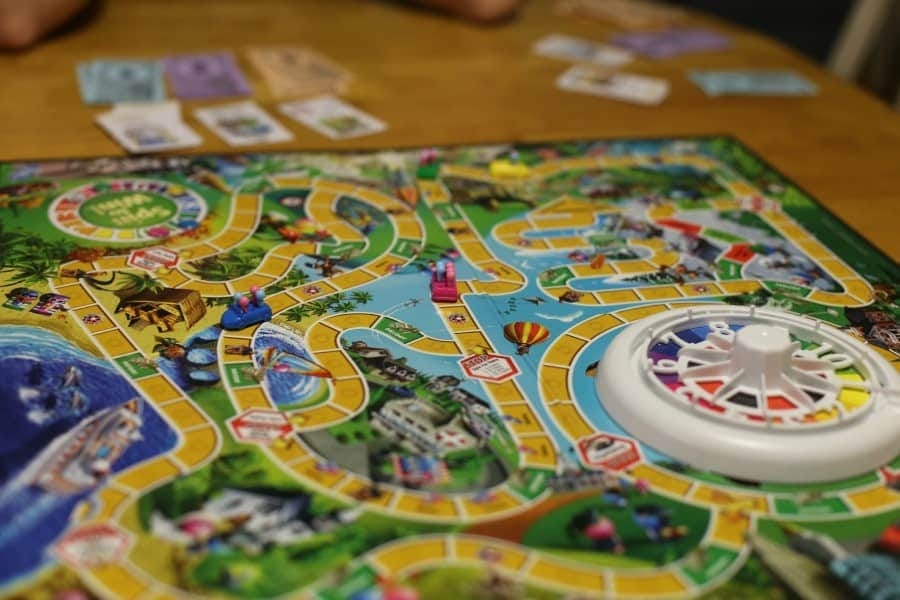
[Hasbro’s Game of Life board game]
Writing for Routledge Encyclopedia of Philosophy and reflecting on Sartre’s Being and Nothingness (1943), Christina Howells expresses how much influence facticity has: [2]
One’s situation may be modified, but it [facticity] still constitutes the starting point for any change, and roots consciousness firmly in the world about it [facticity].
I am not free to change a whole multiplicity of aspects of my condition, and those I am free to change may not prove easy. As I live I create a self which does not bind me but which certainly makes some courses of action easier and more attractive than others.
She observes the self image we’ve created for ourselves and the images that others hold us further imply the limits of the “range of possibilities” open to us. That image of who we are, who others consider us to be has been assembled and created so each of us have the option, at any point, “to ‘act out of character’” but we’re not likely to find it easy to do.
Sartre, according to Christina, considered our self less character and more project in that our sense of self has been formed piece by piece gradually across our lifetimes and “not necessarily the result of” consciously-made decisions. The self we’ve formed assembles all that has come before into some “meaningful whole” we come to see as defining who we essentially are. Making meaningful changes can be hard since “the decision to make significant changes always comes up against resistance from already existent patterns and structures.”
Christina concludes:
In 1943, then, Sartre already sets freedom firmly against a background of constraint – constraints which arise from the features of the material world, from other people whose projects may not coincide with mine, from bodily existence, from facticity and from fear of freedom itself.
Fear of freedom? Let’s explore that next post.
To be fair, facticity as a term was first used by German philosopher Johann Gottlieb Fichte (1762–1814) and has been defined with a variety of meanings since, including the one Sartre proposed.
Various definitions include:
the quality or state of being a fact
the state of being in the world without any knowable reason for such existence
being in a particular state of affairs which one has no control over
a fact that is not changeable or that is assumed to be true without further evaluation
Wiktionary: facticity
For German philosopher Martin Heidegger (1889–1976) … “‘thrownness’ … individuals are ‘thrown into the world.’”
For French existentialists Jean-Paul Sartre (1905-1980) and Simone de Beauvoir (1908-1986), “facticity signifies all of the concrete details against the background of which human freedom exists and is limited.”
Wikipedia: Facticity
Everything can be taken from a man but … the last of the human freedoms – to choose one’s attitude in any given set of circumstances, to choose one’s way. ~ Viktor Frankl
Between stimulus and response, there is a space. In that space lies our freedom and our power to choose our response. Stephen Covey
Until one is committed, there is hesitancy, the chance to draw back, always ineffectiveness. Concerning all acts of initiative (and creation), there is one elementary truth the ignorance of which kills countless ideas and splendid plans: that the moment one definitely commits oneself, then providence moves too. A whole stream of events issues from the decision, raising in one’s favor all manner of unforeseen incidents, meetings and material assistance, which no man could have dreamt would have come his way. I learned a deep respect for one of Goethe’s couplets: Whatever you can do or dream you can, begin it. Boldness has genius, power and magic in it!” W. H. Murray [3]
[1] Stanford Encyclopedia of Philosophy: Jean-Paul Sartre, Jack Reynolds and Pierre-Jean Renaudie
[2] Sartre, Jean-Paul (1905–80), 3. Being and Nothingness, Christina Howells, Routledge Encyclopedia of Philosophy
[3] Wikiquote: W. H. Murray